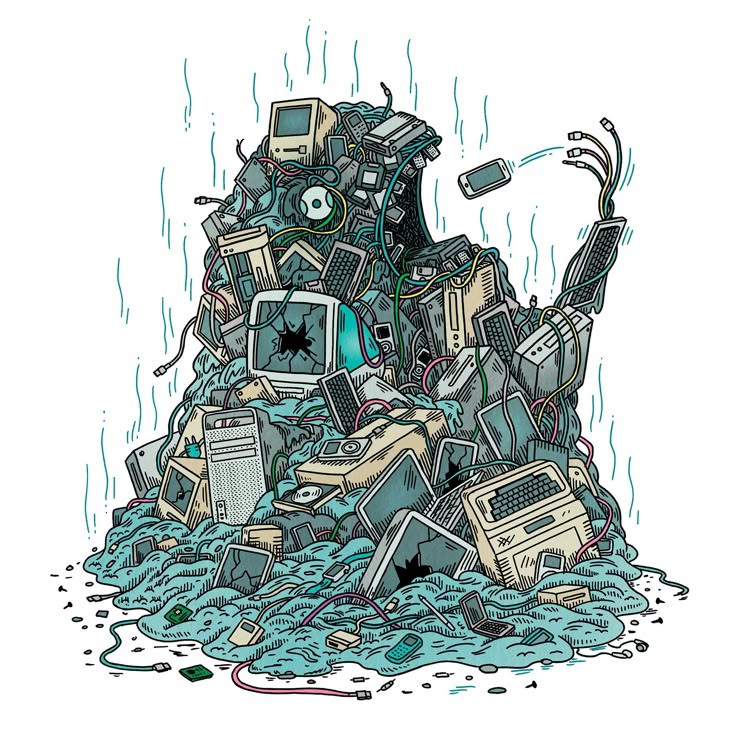
Update cycles represent industrial depletion architecture that systematically degrades hardware performance, accelerates replacement schedules, and externalizes environmental costs.
The update is not progress delivery. It is depletion mechanism.
THE MAINTENANCE ILLUSION
Software vendors market updates as necessary improvements. Documentation emphasizes security patches, performance enhancements, and new features. These metrics create the appearance of iterative improvement.
The reality operates differently. Update architecture implements planned depletion through layered degradation. Each update cycle introduces cumulative performance overhead. Each feature addition requires hardware resources. Each security patch creates compatibility requirements. The system presents as maintenance while operating as systematic obsolescence.
This arrangement functions as industrial depletion: software that degrades hardware through calculated performance erosion.
DEPLETION CASCADE ARCHITECTURE
Software update systems implement hardware depletion through three interconnected cascades:
Each cascade reinforces hardware depletion. Performance degradation creates user frustration. Compatibility breakage creates functional obsolescence. Feature dependency creates capability exclusion.
THE DEPLETION LAYER: SOFTWARE AS INDUSTRIAL POLICY
Software vendors initially present updates during device lifecycle as value preservation. They emphasize extended support, continued security, and feature access. This phase follows the logic of customer retention—maintaining engagement through perceived improvement.
The depletion phase emerges at scale. Update economics shift from customer satisfaction to replacement scheduling. Performance overhead becomes calculated degradation. Feature additions become hardware requirements. Security patches become compatibility breakers. The vendor's product team dictates hardware retirement schedules.
The technical justification—security requirements, feature parity, performance optimization—serves as industrial cover for planned depletion. The update becomes the depletion timer.
Modern software does not run on hardware. It consumes it.
WASTE MATRIX: HOW UPDATES GENERATE E-WASTE
Software update policies create predictable hardware waste patterns:
The implementation varies; the outcome converges: software that systematically generates hardware waste.
TIMELINE OF DEPLETION: THE ACCELERATING CYCLE
The progression of software-hardware dependency reveals accelerating depletion:
The trend is exponential: each era halves hardware effective lifespan through software-mediated depletion.
ECONOMICS OF DEPLETION: TWO MODELS
The software-hardware relationship follows two competing economic models:
The current technology industry operates almost exclusively on the depletion economy model, with software as the primary depletion mechanism.
CIRCULARITY GAP ANALYSIS
Modern software-hardware ecosystems exhibit specific circularity failures:
Each gap represents not just environmental cost, but systemic failure of circular economic principles.
ENVIRONMENTAL COST ACCOUNTING
THE EXTERNALIZED BURDEN
Software-mediated hardware depletion externalizes environmental costs through precise mechanisms:
1. Carbon debt acceleration: Each premature device retirement wastes the carbon expended in manufacturing (estimated 85% of device lifetime carbon footprint). Software updates that shorten device lifespan by 50% effectively double per-year carbon emissions.
2. Toxic debt accumulation: Lead, mercury, cadmium, and brominated flame retardants enter waste streams at accelerated rates. Software update policies that drive 2-year replacement cycles instead of 5-year cycles increase toxic material flow by 150%.
3. Rare earth depletion: Neodymium, dysprosium, praseodymium used in magnets and displays are mined, processed, and discarded at software-dictated rates. Each iOS update that renders older iPhones obsolete consumes approximately 0.5kg of rare earth elements per million devices.
4. Water and soil contamination: Mining for replacement components and improper e-waste disposal contaminates water systems. Software companies have successfully externalized these costs to mining communities and developing nations.
THE REGULATORY ARBITRAGE
Software companies operate in regulatory gaps: hardware environmental regulations don't cover software-mediated depletion, while software regulations don't address environmental impacts. This allows Apple to claim environmental progress while engineering iOS updates that systematically degrade older iPhones.
DIAGNOSTIC FRAMEWORK
To measure software-mediated depletion in any ecosystem, evaluate four diagnostic dimensions:
Ecosystems scoring high across all four dimensions have transformed software updates into industrial depletion systems.
DEPLETION-RESISTANT ARCHITECTURE
Current software development follows feature velocity logic. Alternative models exist in industrial design history. The Fairphone demonstrates hardware designed for longevity and repairability. The Framework laptop shows modular, upgradeable architecture. The Right to Repair movement advocates for user serviceability.
Depletion-resistant software requires architectural discipline from initial design:
Performance preservation contracts: Commit to maintaining or improving performance with each update.
Hardware abstraction layers: Design software to run on multiple hardware generations without degradation.
Resource efficiency metrics: Measure and optimize for CPU, memory, storage, and battery impact.
Backward compatibility guarantees: Maintain driver and peripheral support across update cycles.
User-controlled update schedules: Allow deferral or rejection of feature updates while maintaining security.
Modular software architecture: Enable component updates without full system replacement.
Environmental impact accounting: Calculate and disclose hardware depletion costs of each update.
These practices trade feature velocity for hardware preservation. They reject depletion economics in favor of circular design principles.
THE DEPLETION TRAP CYCLE
Software-mediated hardware depletion follows a predictable environmental debt accumulation pattern:
1. Initial adoption: Hardware performance meets software requirements with overhead. Users experience smooth operation.
2. Update accumulation: Each software update adds performance overhead, reduces available resources, introduces compatibility requirements.
3. Performance degradation: Hardware becomes sluggish, battery life decreases, storage fills with update files. User frustration increases.
4. Feature exclusion: New software features require hardware capabilities absent in older devices. Users feel technologically left behind.
5. Security abandonment: Vendor ends security updates for older hardware. Devices become vulnerable, forcing replacement.
6. Environmental debt externalization: Depleted hardware enters waste stream. Environmental costs transferred to society, developing nations, future generations.
The cycle completes when environmental debt becomes irreversible while profits remain privatized.
SYSTEM NOTES
The most environmentally destructive software feature is the one that makes perfectly functional hardware feel obsolete.